

Do you believe in karma?
What If Karma Isn’t About Revenge?
It is important to understand that karma is not necessarily a cosmic judge or an instant punishment system that appears whenever someone does something wrong.
For as long as I can remember, I have considered myself a student of the idea of karma, even though I did not always understand its deeper meaning. For a long time, I simply associated karma with punishment for wrongdoing.
It is normal to believe in something. Beliefs can empower us, guide our conscience, and give us something to aspire to. But belief alone is rarely enough.
For example, if you believe you will become wealthy, you cannot simply pray for wealth and wait for it to arrive. You have to put that belief into practice by participating in activities that can create wealth.Yet even when two people follow similar paths, they may experience completely different outcomes.
And still, I believe in karma.
Look around us. With the level of aggression, wickedness and violence we witness in the world, some people argue that karma is overrated. They ask: Where is the punishment? Why do people who hurt others sometimes seem to live perfectly comfortable lives?
They have a point.
It is rare to witness someone who wronged you receive an exact or proportional punishment for their actions.Sometimes, people hurt others and appear to get away with it.
But perhaps this is where our understanding of karma needs to change.
Karma, in many traditions, is understood as a principle of cause and effect. An intentional action can set off a chain of consequences, much like planting a seed creates the possibility of a particular plant growing.
But even that analogy has limitations.
Not every seed grows.
Some are planted but never receive enough water. Some are destroyed by the weather. Others grow differently from what we expected.
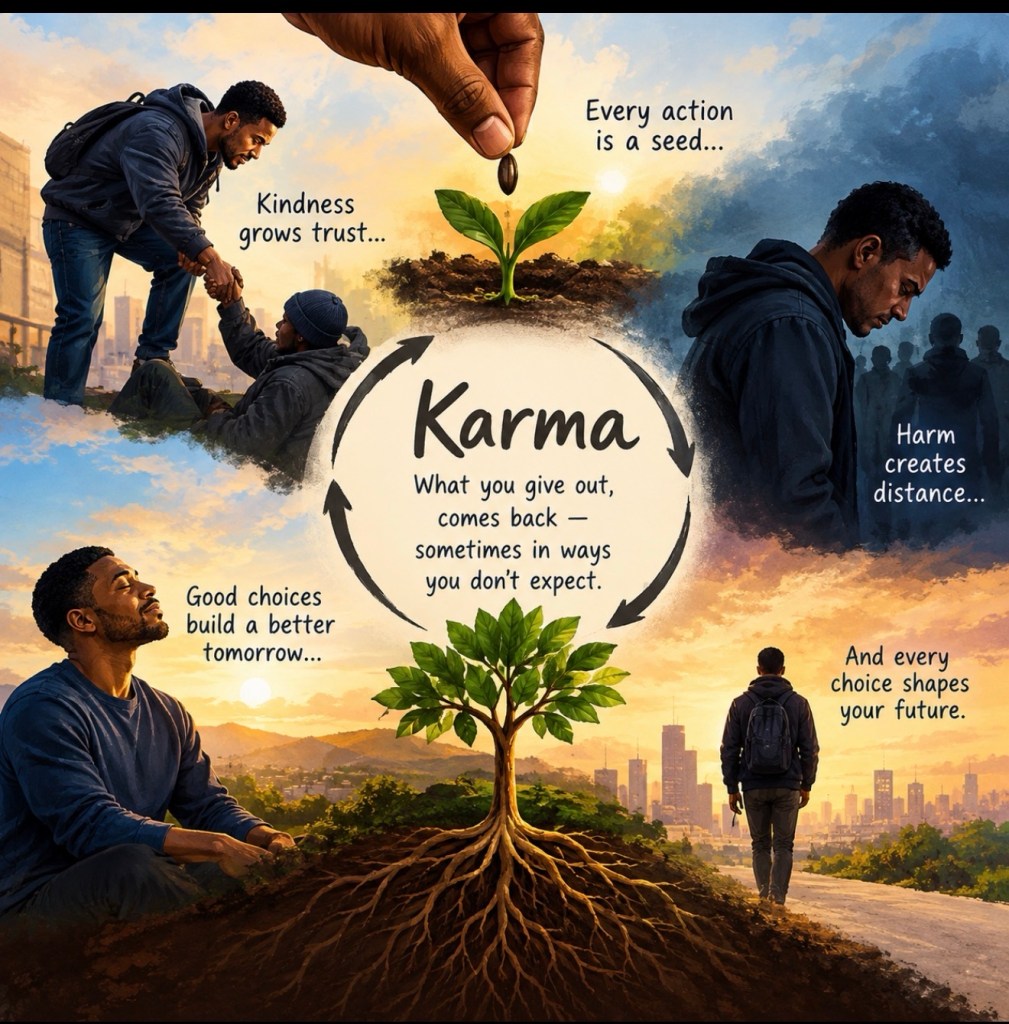
The older I become, the more I understand that the meaning of karma can differ from one person to another, depending on their beliefs, experiences and circumstances.
And perhaps karma is not only about what we do physically but also how we think and our choice of words.
Our thoughts influence our words. Our words influence our actions. Our actions become habits, and our habits gradually shape the lives we live.
In that sense, perhaps karma isn’t always about someone else being punished.
Sometimes, the consequence is simply becoming the person our choices have created.
If you constantly choose anger, you may build a life surrounded by conflict. If you choose kindness, you may build relationships rooted in trust.If you repeatedly deceive people, you may eventually find yourself surrounded by people who no longer trust you.
These consequences may not arrive dramatically. There may be no lightning from the sky, no mysterious punishment, and no moment when the universe announces that justice has been served.
Sometimes, consequences are much quieter.
They grow slowly.They become part of us.
So, do I believe in karma?
Yes, I do.
But I no longer believe karma works according to my assumptions or according to the punishment I think someone deserves for offending me.
I believe that our choices have consequences—sometimes directly, sometimes indirectly, sometimes immediately, and sometimes years later. We may never see every consequence or know what happened to the person who hurt us,
And perhaps we don’t need to.
Because life has a way of teaching us that what we repeatedly put into the world can eventually shape the world we live in.
We may not always receive exactly what we give, but we rarely remain completely untouched by what we repeatedly choose to give.

